Used Car Prices in China 2026: The August Drop Explained for Importers
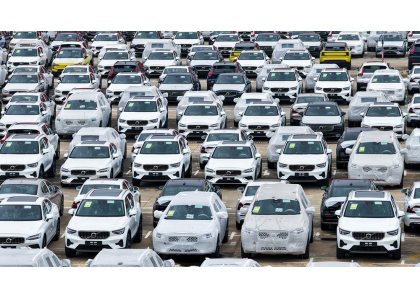
The average used car in China changed hands for less money in August 2026 than in July - and not by a rounding error. Dividing the official transaction value by the official transaction volume gives RMB 63,953 per car in August against RMB 66,899 in July, a fall of 4.4% in a single month. Both figures come from China Auto Dealers Association (CADA) data reported by Sina Finance on 20 September 2026; the per-car averages are our own division, not a published number.
For an importer, a 4.4% monthly fall in source prices is a buying opportunity - but only in one corner of the market. The rest of this article explains where the discount actually sits, and where it does not.
What the Official Numbers Show
|
Metric |
July 2026 |
August 2026 |
|
Transactions |
1.5616 million |
1.5163 million |
|
Month-on-month volume |
-3.51% |
-2.90% |
|
Year-on-year volume |
-5.98% |
-11.19% |
|
Transaction value |
RMB 104.47 bn |
RMB 96.972 bn |
|
Implied average price |
RMB 66,899 |
RMB 63,953 |
Cumulative January to August volume reached 12.7911 million units, down 1.14% year on year - a market that is shrinking, not collapsing, but shrinking faster as the year goes on. August's 11.19% year-on-year decline is nearly double July's, which tells you the weakness accelerated rather than stabilised.
Why Prices Fell: The Petrol Collapse
This is not a quality problem or a confidence shock. It is a fuel-type problem. CADA's September 2026 passenger car analysis, published 12 October, records retail sales of 1.618 million passenger cars, down 28.0% year on year, with fuel-burning cars down 43% and pure petrol down 49%. New energy vehicles reached 67.0% of retail sales - a record - while ordinary hybrids grew 25%.
The mechanism is straightforward. Petrol prices rose by a cumulative RMB 2,375 per tonne during 2026, and Chinese buyers responded by abandoning petrol cars faster than dealers could clear them. Those cars do not disappear; they flow into the used market, where supply now exceeds domestic demand. That is what the 4.4% monthly price fall measures.
CADA also notes that the traditional September-October peak season was weaker than in previous years, with dealers describing it as a period of stock competition rather than growth. Weak seasonality plus rising petrol-car supply is a recipe for lower prices.
Why This Matters More to Exporters Than to Chinese Buyers
The domestic collapse and the export boom are two halves of one story. In September 2026 China exported 917,000 passenger cars including CKD units, up 73.7% year on year, equal to 36% of manufacturer sales, according to CPCA data cited by CADA. New energy vehicles made up 60.8% of those exports.
Read that again: the export channel is now overwhelmingly electric, while the domestic glut is overwhelmingly petrol. Those two facts do not cancel out - they create a specific arbitrage. Petrol cars are being pushed out of Chinese cities and are cheap at origin. Meanwhile most of the markets that buy used Chinese cars - West Africa, the Gulf, Central Asia, Latin America - are petrol markets with no charging infrastructure and no appetite for a battery car.
Which Stock Gets Cheaper, and Which Does Not
|
Segment |
Direction in 2026 |
Importer implication |
|
Petrol sedans and SUVs |
Falling hard (retail -43% fuel) |
Best discount; negotiate hard |
|
Ordinary hybrids (HEV) |
Rising (retail +25%) |
Firmer prices; less room |
|
Battery electric |
Supply thin in used market |
Scarce, priced on novelty |
This matters because the reflex is to chase the cheapest listing. The cheapest listing is usually a petrol car in a segment Chinese buyers have walked away from - which is exactly what a Nigerian or Iraqi dealer wants. The two incentives happen to align.
What to Buy in This Window
· Petrol compact sedans: the deepest discount, the widest supply, and the easiest to service anywhere. A 1.5-litre naturally aspirated car with a CVT is the least risky import in the current market.
· Petrol and hybrid midsize SUVs: seven seats and ground clearance still command a premium in emerging markets, and hybrid versions are holding value better than petrol equivalents.
· Avoid buying purely on price: a car discounted 15% because it sat unsold for eight months may also have a flat battery, stale fluids and a service gap. Inspection matters more when prices are falling.
For the discount side of the market, a Used Car Toyota Yaris L 2022 Leading Edition is the template: 1.5-litre petrol, CVT, 27,000 km, two keys and original paint - cheap at origin, simple to maintain at destination. For the value-holding side, a 2024 Toyota Highlander Dual Engine 2.5 Hybrid 4WD Premium 7-Seater shows the opposite logic: a 2.5-litre hybrid with E-Four all-wheel drive and seven seats, the kind of car that still sells at a premium because fuel economy and space are what family buyers pay for.
The Risks Worth Pricing In
First, falling prices can keep falling. A car bought in October at a 4.4% discount to July may look 8% expensive by December if the petrol retreat continues. Importers buying on credit should assume one more leg down and stress-test the margin accordingly.
Second, age limits do not care about price. Markets that cap import age will still reject a cheap 2019 car, whatever the discount. Falling prices improve the deal only on stock that is young enough to enter.
Third, the export compliance regime has tightened. China now requires third-party inspection and verified service history on exported used cars, and the near-zero-mileage trade has been explicitly restricted. Budget for inspection and documentation, and treat a seller who cannot produce it as a red flag.
Conclusion
Chinese used car prices are falling for a clear, measurable reason: domestic petrol demand is collapsing under high fuel costs, and the resulting supply is overwhelming local dealers. The discount is real, it is concentrated in petrol cars, and it is precisely the stock that most emerging markets actually want. Buy the discount, not the headline - and verify condition before you commit.


